

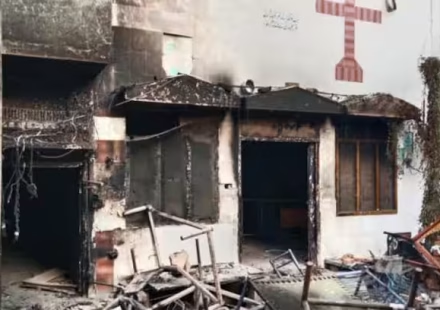
The Ashes of Jaranwala: Mob Violence and State Failure Expose the Vulnerability of Pakistani Christians
JARANWALA, PAKISTAN — A catastrophic wave of organized mob violence in the industrial district of Jaranwala, located in Pakistan’s Punjab province, has left multiple Christian enclaves devastated, scores of homes looted, and historic churches reduced to ashes. Triggered by unverified blasphemy allegations against two local Christian brothers, the coordinated assault stands as one of the most severe escalations of sectarian violence in recent history, laying bare the ongoing failure of local law enforcement to safeguard vulnerable minority citizens.
The violence erupted rapidly following reports that torn pages of the Quran, accompanied by allegedly derogatory remarks, were discovered near a Christian settlement. Within hours, thousands of rioters—incited by announcements from local mosque loudspeakers and social media networks—converged on the Christian neighborhoods, forcing hundreds of families to flee into nearby fields to escape potential lynchings
Systemic Destruction and Desecration
What followed was a systematic campaign of arson and vandalism that targeted both private properties and sacred spaces. Human rights monitors on the ground documented absolute devastation:
Destruction of Places of Worship: Rioters targeted historic churches, including the Salvation Army Church and the local Catholic parish. Shrines were breached, altars smashed, and Bibles intentionally burned or trampled.
Targeted Arson of Residential Enclaves: At least four major Christian settlements were ransacked. Elements within the mob looted valuable belongings, ruptured gas pipelines, and utilized chemicals to set fire to dozens of Christian homes, rendering them structurally uninhabitable.
Destruction of Communal Infrastructure: Local schools, community centers, and businesses owned by Christians were systematically targeted to maximize long-term economic paralysis.
Institutional Apathy and Delayed Law Enforcement
A central point of outrage among rights advocates and community leaders is the documented paralysis of local security apparatuses. Witnesses reported that despite early warnings and initial smaller gatherings, local police failed to establish a defensive perimeter around the Christian sectors, allowing the crowds to swell into uncontrollable numbers.
While the provincial government eventually deployed paramilitary forces (the Punjab Rangers) to restore order and arrested over a hundred suspected rioters, advocates argue that these measures are purely reactive.
"Deploying troops after neighborhoods have been burned to the ground is an admission of institutional failure," noted human rights legal experts. "The state has consistently failed to prosecute the instigators of mob violence in past crises—such as Gojra and Joseph Colony—creating a culture of absolute impunity for perpetrators of sectarian terrorism."
The Road to Structural Justice
For the displaced families of Jaranwala, the trauma extends far beyond physical loss. Many are low-wage sanitation workers and laborers who have lost their entire life savings and ancestral homes in a single afternoon.
Civil society organizations standing with Justiceforth.org emphasize that true restitution cannot be achieved through temporary government stipends or superficial structural repairs. Preventing future atrocities requires the state to directly address the root causes of communal violence: the systemic weaponization of blasphemy laws to settle personal or property disputes, and the lack of robust, preventative security frameworks for minority enclaves.
Justiceforth.org calls for an independent judicial inquiry into the law enforcement failures in Jaranwala, swift prosecution of the inciters under anti-terrorism statutes, and immediate, comprehensive state protection for all vulnerable religious communities.

One Year Later: Police Failure and Unanswered Questions in the Deadly Ambush of Pastor William Siraj
PESHAWAR, PAKISTAN — The ongoing investigation into the targeted assassination of Pastor William Siraj—who was ambushed and shot dead by unidentified gunmen on the ring road of Peshawar—remains a stark reminder of the state’s inability to protect high-profile religious minority leaders. Despite repeated assurances from provincial law enforcement and counter-terrorism units, the lack of definitive judicial outcomes continues to foster a culture of fear and impunity.
Pastor Siraj, a 75-year-old retired teacher and beloved minister of the Church of Pakistan, was driving home from a Sunday service alongside his colleague, Pastor Patrick Naeem, when two assailants on a motorcycle opened fire on their vehicle. Siraj died instantly from multiple gunshot wounds, while Pastor Naeem survived with non-life-threatening injuries.
The brazen, daylight execution sent shockwaves through the region's Christian community, drawing immediate comparisons to the horrific 2013 All Saints Church bombing in Peshawar.
A Pattern of Investigatory Dead Ends
In the immediate aftermath of the killing, senior police officials declared a high-level security alert, utilizing CCTV footage and forensic evidence to trace the perpetrators. Counter-terrorism departments initially claimed to have made significant breakthroughs, including the elimination of suspected militants allegedly linked to the planning of the ambush.
However, human rights monitors and legal advocates tracking the case note a highly predictable pattern of institutional stall tactics:
Failure to Uncover Networks: While localized skirmishes often result in the deaths of foot soldiers, the broader extremist networks, ideological instigators, and financial backers behind targeted assassinations are rarely exposed or brought to trial.
Lack of Judicial Transparency: The families of victims are routinely left in the dark, with court proceedings shrouded in bureaucratic delays and counter-terrorism cases frequently stalling in specialized tribunals without public accountability.
Inadequate Witness and Survivor Protection: Survivors, including Pastor Naeem and key eyewitnesses, are often left to navigate intense psychological trauma and ongoing security threats with minimal state-sponsored protection.
The Eradication of Moderate Voices
The assassination of Pastor Siraj was not an isolated incident; it represents a coordinated effort to silence moderate religious voices and community leaders who advocate for interfaith harmony and minority rights within Khyber Pakhtunkhwa province.
For decades, the Christian community in Peshawar has served as a resilient but highly vulnerable enclave. When religious leaders are targeted with impunity, it sends a chilling message to the entire community: the state cannot, or will not, guarantee their fundamental right to life and security.
The Demand for Structural Accountability
Civil society organizations standing with Justiceforth.org argue that temporary condemnations by state officials do nothing to dismantle the structural threats facing religious minorities. True deterrence requires a transparent, independent judicial review of the investigation, the public prosecution of all co-conspirators, and a comprehensive overhaul of provincial threat-assessment protocols for vulnerable community figures.
Justiceforth.org demands that the Pakistani federal and provincial authorities fulfill their constitutional obligations, break the cycle of investigatory failure, and deliver transparent, long-awaited justice for the family of Pastor William Siraj.